Access work in progress here. Sorry, mobile version is not ready yet so use your desktop to view.
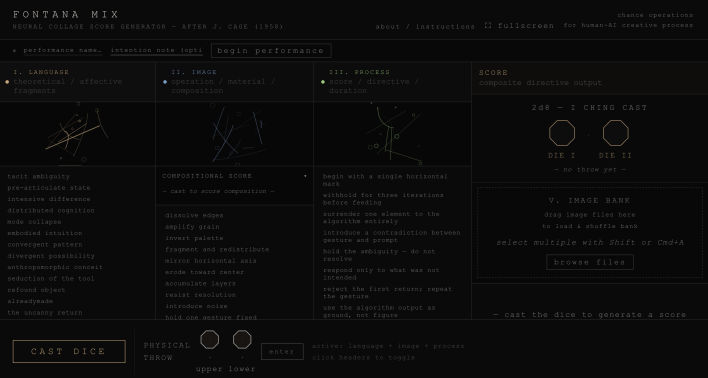
FONTANA MIX
neural collage score generator — after J. Cage (1958)
Developed by SK Choi in dialogue with Anthropic’s Claude as a cognitive autoethnographic study of human-AI co-creation.
after John Cage, Fontana Mix (1958) · project initiated Spring 2026
what this is
A chance-operations score generator for human-AI co-creative practice — specifically for iterative dialogue between autographic gesture and AI image generation (Stable Diffusion image-to-image workflows). Each cast of two eight-sided dice produces a composite score across three sheets: theoretical-affective vocabulary (Language), operational image directives (Image), and temporal-durational instructions (Process). The score is not a prescription. It is a field that the artist enters and completes through practice.
the three sheets
The instrument draws from three vocabulary sheets on each cast. Each sheet column has a coloured dot beside its header — this dot indicates the sheet is active and can be toggled on or off by clicking the header. Toggling a sheet off excludes it from the cast entirely: no items are selected from it, it does not contribute to the score card, and its mark field dims. This allows you to work with any combination of one, two, or all three sheets — for example, using only Language and Process without Image directives, or casting from a single sheet for a more focused score.
The dot behaves differently depending on when you toggle. Before a cast: toggling a sheet off dims the entire column — the dot darkens, the mark field fades, all items go dark. The sheet reads as simply inactive. After a cast (settled): toggling a sheet off dims the column, but the activated items were already illuminated by the cast. They dim back toward dormant, and the dot dims — but there is a residual warmth from the settled state that makes the dimming look different from a pre-cast toggle. This is correct: the two states are genuinely different. In both cases, the next cast will exclude a toggled-off sheet regardless of when it was toggled.
The Score column (IV) has no dot because it has no toggle — it is the output of the cast, not a pool to draw from.
I. Language — Theoretical and affective fragments drawn directly from the research framework of neural collage practice: Deleuzian vocabulary (intensive difference), embodied cognition (Varela), and terms coined within the practice itself (refound object, alreadymade, the almost-known). Three items are activated per cast. They function as conceptual-affective orientation for the session — not as tasks.
II. Image — Operational directives derived inductively from actual studio practice: real procedural moves in the iterative exchange between hand and machine. Three items are activated per cast. The compositional diagram (placement principle, rotation, scale) is an additional spatial score generated from the same throw. It is a suggestion. Human obstinacy prevails.
III. Process — Temporal and durational scores drawing on Cage’s process logic and autoethnographic observation of how the human-AI session unfolds in time. Two items are activated per cast. They govern the session as a whole: sequencing, duration, the decision of when to stop.
the generated mark fields
Each of the three sheet columns is headed by a generated field of marks — lines, arcs, curves, and rectangles. These are not decorative. They are produced by the same deterministic seed as the cast: the same sequence of numbers that selects the vocabulary items also determines the position, weight, and opacity of every mark in the field. The visual composition and the textual score are one event seen in two registers simultaneously.
The marks are causally related to the cast but not symbolically related to the I Ching. There is no iconographic correspondence between a hexagram and a particular mark type or configuration — the relationship is structural, not interpretive. Think of it as the cast expressed spatially rather than linguistically: the same throw, read differently.
When a sheet is inactive (toggled off by clicking its header), its mark field fades. When active, it illuminates at full opacity. The mark field is the sheet’s visual identity — it changes with every cast, making each score visually distinct as well as textually distinct. After a cast, dormant (unselected) vocabulary items dim back and the mark field settles — the score asserts itself against the pool from which it was drawn.
the dice and the I Ching
Two eight-sided dice are cast — digitally or entered from physical dice. Each die face maps to one of the eight I Ching trigrams (☰ Heaven through ☷ Earth). Their combination yields one of 64 hexagrams — the complete set of the I Ching. The hexagram number deterministically seeds all score selections: the same throw always produces the same score, making results citable and reproducible as research data. This follows John Cage’s use of the I Ching from the early 1950s — not as randomness, but as a fixed yet impersonal mapping that displaces personal preference without abandoning structure.
relationship to Cage’s Fontana Mix (1958)
Structurally referential, not directly derived. Cage’s original consists of ten transparent sheets — carrying lines and points — overlaid in any combination, with the performer reading intersections as instructions. This instrument preserves three elements from that logic: multiple simultaneous sheets (Language, Image, Process are overlaid, not sequential); chance operations as compositional method; and the score as a generative field rather than a fixed instruction set. It departs from Cage’s graphic overlay method and the open indeterminacy of performer interpretation — the vocabulary here is fixed, the selections deterministic, the directives textual rather than graphical.
the open work
Following Umberto Eco’s Opera Aperta (1962), this score is conceived as an open work: a structured field of possibility that the artist completes through the act of practice. The score does not determine the work. It opens a space in which the work becomes possible. Each of the 64 hexagrams is a different opening of that space.
image bank (V)
An optional pool of source images that the cast draws from — one image surfacing per throw alongside the score directives, shown in full. The bank is managed through a single panel opened with manage (or load images when empty).
Loading is accretive. Add files or whole folders, from any number of sources, in any number of passes — images accumulate in a staging area rather than replacing what came before. Review the staged thumbnails, remove any you don’t want, then done loading commits them. You can re-open the manager and add more at any point during a performance; new images integrate with the images not yet drawn.
Order on commit. Choose how committed images are sequenced: shuffle (chance, the default), added (the order loaded — browser delivery order, usually filename), name (filename, sorted within each source folder), or date (capture date, for documentary sequences). Ordering applies only to images not yet drawn; it never disturbs the record of what has been used.
Each image is a single identity with its own history. An image is counted as used only if it was the current image at the moment the next cast was thrown — the throw is the point of commitment. Before that, you may change the current image freely (a form of preference-browsing): open the manager and click any image to place it in the current cast. These provisional changes are recorded in the log but not counted as use. You may also deliberately re-use an already-used image — placing one image across a span of casts to localise a region of the developing work. Re-use is intended, recorded, and never duplicates the image; its use-count (×N) simply rises.
Every draw, override, and re-use is written to the performance log as a timestamped, tagged event, so the full negotiation between the chance sequence and the artist’s obstinacy becomes part of the record — the trace where the tacit modality of process becomes visible. Duplicate files (identical name, size, and date) are detected on load and offered for removal; genuinely different images sharing a name are kept and marked (alt).
the image bank and indeterminacy
The bank does not contradict the instrument’s chance-operational ground — it completes it. An instrument that permitted only obedience to the draw would be a stricter oracle but a poorer research instrument: it could not record the artist working with, around, and against the sequence. The chance sequence is the ground; the artist’s moves with and against it are the figure. Both are recorded — the trace where the tacit modality of process becomes visible.
bank controls
manage opens the pool panel — the single surface for loading, ordering, culling, override, and re-use. hide / count toggles the “images remaining” counter (useful during presentation). Inside the manager: add files / add folder stage more images; reshuffle re-randomises only the images not yet drawn (used images keep their place and history, and are never lost); clear bank unloads everything and empties the library. Reshuffle, commit, removal, override, and re-use are each recorded in the performance log.
Images are held in memory only — closing and reopening the file requires reloading them. The path of each image (its folder-relative location at load time) is captured with the record so images can be located again later; the performance log and session record are preserved through the auto-download on ending a performance.
the SD prompt directive
The SD Prompt Directive shown at the bottom of the score card is a condensed composite drawn from the cast selections — a subset of the subset. One item is selected at random from each sheet’s activated pool (one from the Language selections, one from the Image selections, one from the Process selections), joined by em-dashes with a closing period. Unlike the score itself — which is fully determined by the throw and always reproducible — the prompt selection is genuinely open: the same hexagram cast twice will produce the same score directives but potentially a different prompt each time. Up to 18 different prompts are possible from any single cast (3 Language × 3 Image × 2 Process selections). The prompt is not the score — it is a variable secondary layer, a way of speaking the score to the machine. The score is the oracle’s word; the prompt is how you choose to address the algorithm with it. It can be ignored, modified, or used as written. The word “algorithm” may be read as referring to any generative transformation process — not exclusively Stable Diffusion.
score card ordering
The score card displays selected items in the order they were drawn by the seeded RNG — the oracle’s sequence, which is the sequence of the cast as a temporal event. The vocabulary pools in the three sheet columns display items in their fixed structural order (top to bottom as written). These will differ. The oracle’s sequence and the structural sequence are two different readings of the same cast. A toggle between the two views is planned for a future version.
future development
Each sheet is planned for expansion to exactly 64 items — one per hexagram — enabling direct indexical mapping (hexagram number → specific item) and structural coherence with the I Ching’s complete 64-hexagram system. At present, items are selected by seeded shuffle from each sheet’s vocabulary. The physical dice entry preserves the talisman quality of the throw as the primary event; the tool reads the oracle.
SK Choi / Anthropic Claude · cognitive autoethnographic study of human-AI co-creation
developed as part of ongoing research into neural collage practice
click ⛶ fullscreen in the header for fullscreen instructions


