Author Archives: Suk Kyoung Choi

“The AI Laocoön: Art and the Artificial Imagination or, Survival Aesthetics in the Anthropocene” in Leonardo (2023)
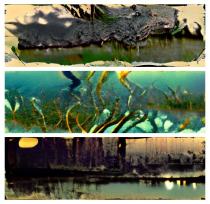
Suk Kyoung Choi, The Drowned World triptych, series 001. (© Suk Kyoung Choi) from Choi’s article “The AI Laocoön: Art and the Artificial Imagination, or Survival Aesthetics in the Anthropocene.” Published: June 1, 2023 “The AI Laocoön: Art and the Artificial Imagination or, Survival Aesthetics
“The AI Laocoön: Art and the Artificial Imagination or, Survival Aesthetics in the Anthropocene” in Leonardo (2023)
Suk Kyoung Choi, The Drowned World triptych, series 001. (© Suk Kyoung Choi) from Choi’s article “The AI Laocoön: Art and the Artificial Imagination, or Survival Aesthetics in the Anthropocene.” Published: June 1, 2023 “The AI Laocoön: Art and the Artificial Imagination or, Survival Aesthetics

“What happened to the subject? Mediated anticipation in neural painting” in TechnoeticArts (2021)
Published: November 1, 2021“The (de) situated subjective: a cognitive autoethnography of ‘the New York School’” ispublished in the Technoetic Arts. You can access the paper here. AbstractThis article presents a phenomenology of artistic painting as an anticipatory process. I proposethat
“What happened to the subject? Mediated anticipation in neural painting” in TechnoeticArts (2021)
Published: November 1, 2021“The (de) situated subjective: a cognitive autoethnography of ‘the New York School’” ispublished in the Technoetic Arts. You can access the paper here. AbstractThis article presents a phenomenology of artistic painting as an anticipatory process. I proposethat
The AI Laocoön – text to image in The Drowned World project (2022)
The Drowned World project employs text-driven image synthesis to explore the ambiguous distinction the media introduces between imagination and virtuality. The machine learning technology in these explorations (VQGAN+CLIP) is an amalgamation of a generative adversarial network (VQGAN – Vector Quantized
The AI Laocoön – text to image in The Drowned World project (2022)
The Drowned World project employs text-driven image synthesis to explore the ambiguous distinction the media introduces between imagination and virtuality. The machine learning technology in these explorations (VQGAN+CLIP) is an amalgamation of a generative adversarial network (VQGAN – Vector Quantized
The Cargo Cult series (2020)
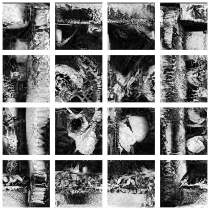
My image-making process—supposedly an internal and personal voyage—questions how much of creative intention is constituted through the unperceived external mediation of experience. Is the artist, as Kurt Vonnegut has suggested, “a canary in a coal mine,” an entity unstuck in
The Cargo Cult series (2020)
My image-making process—supposedly an internal and personal voyage—questions how much of creative intention is constituted through the unperceived external mediation of experience. Is the artist, as Kurt Vonnegut has suggested, “a canary in a coal mine,” an entity unstuck in

Mapping the latent space of neural media (2018)
“Neural media” emerges from deep learning image classification technology. These technologies, broadly construed, group information based on multi-dimensional statistical sampling to build high-level pattern descriptions of diverse input data. Defining information as recombinant patterns of levels of texture-structure enables that
Mapping the latent space of neural media (2018)
“Neural media” emerges from deep learning image classification technology. These technologies, broadly construed, group information based on multi-dimensional statistical sampling to build high-level pattern descriptions of diverse input data. Defining information as recombinant patterns of levels of texture-structure enables that
“The (de) situated subjective: a cognitive autoethnography of ‘the New York School’” in Journal of Visual Art Practice (2022)
Published online: 19 May 2022 “The (de) situated subjective: a cognitive autoethnography of ‘the New York School’” is published in the Journal of Visual Art Practice. You can access the paper here. ABSTRACT In this article I initiate an inquiry
“The (de) situated subjective: a cognitive autoethnography of ‘the New York School’” in Journal of Visual Art Practice (2022)
Published online: 19 May 2022 “The (de) situated subjective: a cognitive autoethnography of ‘the New York School’” is published in the Journal of Visual Art Practice. You can access the paper here. ABSTRACT In this article I initiate an inquiry

The Reflective Machine (2019)
The Reflective Machine engages with an image praxis I call neural painting—a method of using machine learning convolutional neural networks to algorithmically (and agonistically) manipulate and blend natural world derived style palettes with technical imagery I capture in my compositional
The Reflective Machine (2019)
The Reflective Machine engages with an image praxis I call neural painting—a method of using machine learning convolutional neural networks to algorithmically (and agonistically) manipulate and blend natural world derived style palettes with technical imagery I capture in my compositional
“Artistic Style Meets Artificial Intelligence” in Journal of Perceptual Imaging (2021)
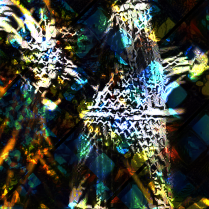
Published online: March 2021 Co-authored paper with Steve DiPaola and Hannu Töyrylä is available online at https://library.imaging.org/jpi/articles/4/2/jpi0139. Abstract Recent developments in neural network image processing motivate the question, how these technologies might better serve visual artists. Research goals to date
“Artistic Style Meets Artificial Intelligence” in Journal of Perceptual Imaging (2021)
Published online: March 2021 Co-authored paper with Steve DiPaola and Hannu Töyrylä is available online at https://library.imaging.org/jpi/articles/4/2/jpi0139. Abstract Recent developments in neural network image processing motivate the question, how these technologies might better serve visual artists. Research goals to date
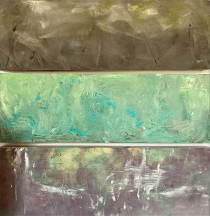
The Drowned World
The drowned world (2019), oil on board, 3 panels 24″ x 8″ each

[video] The Trance Machine (2019), presented at ICCV in Seoul (Korea).
The Trance Machine explores the liminal border between awareness and context. Starting from the idea that every image is a composition of successively smaller images, an ever-changing manifold of frames within frames, the artists’ vision holds a tacit conversation
[video] The Trance Machine (2019), presented at ICCV in Seoul (Korea).
The Trance Machine explores the liminal border between awareness and context. Starting from the idea that every image is a composition of successively smaller images, an ever-changing manifold of frames within frames, the artists’ vision holds a tacit conversation
 Suk Kyoung Choi